
The Shakespeare Name
“For a good Poet's made, as well as borne.”
Ben Jonson, To the Memory of My Beloved the Author, Mr. William Shakespeare.
The Name of William Shakespeare
The name 'William Shakespeare' is a pseudonym referring to an illumined person who is able to inspire others with the wisdom that he or she knows as a result of his/her illumination.
'William' means 'resolute protector' or 'strong-willed warrior', from the German, Wil-helm, meaning 'helmet of strength'.
Illumined men were known as the Knights of the (Golden) Helmet.
The golden helmet symbolises the knight's illumination, which has been bestowed upon the knight by the goddess of Wisdom, Pallas Athena, the Tenth Muse, leader of the other nine Muses.
Athena's helmet is a shining golden-coloured bronze Attic-style plumed helmet. It is associated with the Cap of Hades, which allows the wearer to become invisible.
Athena inspires her wisdom into the hearts of her knights (i.e. knights of the Rosy Cross, or Rosicrucians), who then, by acting out that wisdom, achieve illumination. Such illumination, like that of saints, bestows a halo on each knight, and it is this halo that is symbolised by the golden helmet.
'Shakespeare' is the descriptive name and meaning of the goddess Pallas Athena, who 'shakes' her 'spear' of inspiring light (wisdom knowledge) at the 'dragons' of ignorance and vice, to inspire them with the wisdom to think and do better.
The myth of Pallas Athena's birth is a symbolic description of someone becoming illumined.
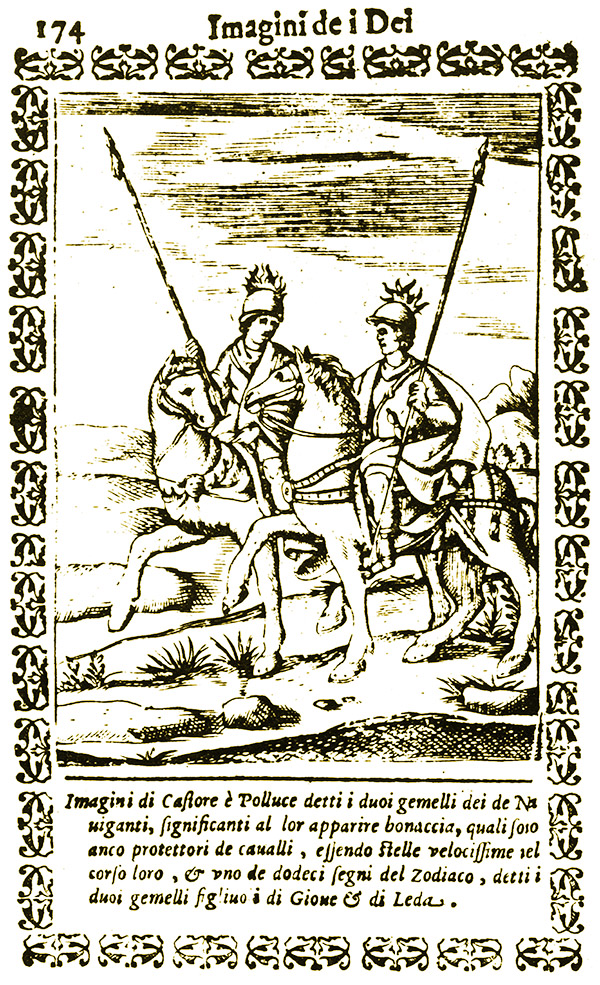
'Shakespeare' also refers to the twin brothers known in classical myth as the Gemini ('Twins'), of whom one is born a mortal (Castor), the other an immortal (Pollux). They are sons of Leda and the Swan, and born from Swan eggs. They love each other deeply and go on many adventures together.
In the course of time the mortal brother dies. Out of love and grief, the immortal brother offers to sacrifice his immortality so as to resurrect his mortal brother to immortality. Zeus grants this wish and, because of their love, he makes them both immortal-mortals, known as the Heavenly Twins. They can both incarnate as mortals, either together or separately, but whilst maintaining their immortal-mortal consciousness and unity in love.
As immortal-mortals, the Gemini are known as Swans and Spear-shakers, or Shake-speares.
This Gemini theme is the foundation of and key to all the Shakespeare works, which is why Shake-speares Sonnets 78 to 86 are known as "the rival poets" sonnets, with Sonnet 83 concluding with:
There lives more life in one of your fair eyes
Than both your poets can in praise devise.
As Ben Jonson says in his enigmatic ode "To the Memory of My Beloved the Author, Mr. William Shakespeare" prefacing the plays in the Shakespeare First Folio:
For a good Poet's made, as well as borne.
And such wert thou. Looke how the fathers face
Lives in his issue, even so, the race
Of Shakespeares minde, and manners brightly shines
In his well turned, and true-filed lines:
In each of which, he seemes to shake a Lance,
As brandish't at the eyes of Ignorance.
Sweet swan of Avon! what a fight it were
To see thee in our waters yet appeare,
And make those flights upon the bankes of Thames,
That so did take Eliza, and our James!
But stay, I see thee in the hemisphere
Advanc'd, and made a constellation there!
The “eyes of ignorance” refer to ignorant minds, which are traditionally symbolised as dragons, as in the portrayal of St George and the Dragon.
St George is a Knight of the Golden Helmet, whose heraldic symbols consist of a Red Cross and a Rose. He is a Rosy Cross Knight (i.e. a Rosicrucian) and a Spear-shaker (or Shake-speare). For this reason Shakespeare (the author or authors) is said to have been born on St George's Day and to have died on St George's Day, so as to make this link apparent. St George is also the patron saint of England, the birthplace of Shakespeare.
"Avon", which simply means ‘River’, refers to the River Thames, as Jonson’s ode to the Author tells us.
The famous palaces on the River Thames where Queen Elizabeth and King James used to see such plays, as part of their entertainment, were York Palace, later called Whitehall Palace, Greenwich Palace, Hampton Court Palace and Richmond Palace.
The "constellation" is Cygnus, 'the Swan'. In this sentence Jonson is confirming that the "Sweet swan of Avon" (the poet) is an immortal-mortal – a mortal who has been raised ("Advanc'd") to immortality as an immortal-mortal, thereby dwelling in the Celestial World – a realm of existence in which the immortal spirit of the Spiritual World (Heaven) is united with the mortal soul of the Natural World (Earth). This, in effect, is the whole purpose of life.
- The Name William Shakespeare
- What's in a Name?
- The Shakespeare Gemini Headpieces
- Beauty, Truth and the Gemini
- Knights of the Helmet & Comedy of Errors
- The Shake-scene
- The Shakespeare Circle
- The Secret Signature
- Tributes to Sir Francis Bacon
- Sir Francis Bacon, the Third Plato
- Francis Bacon, Shakespeare & the Earl of Essex
- The Northumberland Manuscript
- The Philosopher and Secret Poet
- The Stratford Shakespeare Monument
- The 1623 Revelation of the Baconian-Rosicrucian Great Instauration