Bacon's Essays
“Nuptial love maketh mankind; friendly love perfecteth it; but wanton love corrupteth, and embaseth it.”
Francis Bacon, 'Of Love', Essays (1625)
Francis Bacon's essays were a new style of writing. The only such writing previous to Bacon's were the essays of Michel de Montaigne, one of the most significant philosophers of the French Renaissance.
In 1570, Michel de Montaigne became the Lord of Montaigne and inherited the family estate, the Château de Montaigne, where he went to live. Not long after, he was seriously injured in a riding accident on the château grounds. He took some months to recover, and this close brush with death affected him greatly. Because of this, and because his first child was born a few months later, by 1571 he had retired from public life and more or less isolated himself in the tower of the château, which contained his library of some 1,500 volumes, where he began work on the writings that would later be compiled into his Essais ("Essays"), the first edition of which were first published in 1580.
After this, from 1580 to 1581, Montaigne travelled in France, Germany, Austria, Switzerland and Italy, partly in search of a cure. He maintained a detailed journal in which he recorded regional differences and customs, in addition to a variety of personal episodes, which he observed on his journey. (The journal was eventually was published in 1774 under the title Travel Journal.) After his travels, Montaigne returned to Bordeaux and his château.
In August or September 1583, Anthony Bacon arrived in Bordeaux, acting as an intelligencer on behalf of his uncle Lord Burghley and the Queen. Whilst at Bordeaux, Anthony made the acquaintance of Michel de Montaigne, who became a good friend.
In early July 1584 Anthony Bacon travelled to the Kingdom of Béarn, part of Navarre, to pay his respects to Henri de Navarre, who, in June of that year, had become the heir to the throne of France. There he encountered Navarre's Academy, which the king had established the previous year. (The Shakespeare play, Love’s Labour’s Lost, references Navarre’s Academy and caricatures Henri de Navarre as Ferdinand, King of Navarre.) Anthony stayed at Navarre’s Court with Henri and his sister Catharine de Bourbon throughout the rest of the summer and autumn of 1584, and he and Henri became good friends.
By October 1584 Anthony Bacon had moved to Montauban, where he seems to have stayed for several years. But towards the end of 1589 he had left Montauban for Bordeaux, where he lived until the end of 1591. During these two years at Bordeaux, Anthony developed further his friendship with Michel de Montaigne, who had just published (in 1588) Part 2 of his Essais, which contained the essays he had written during the years 1580-1588. A further set (Part 3) of Essais, written between 1588-1592, was to be published in 1595, after Montaigne had died on 13 September 1592.[i]
Whilst in Bordeaux, Anthony Bacon also continued to maintain friendly correspondence with Henry of Navarre, now Henry IV of France, and on 14 April 1590 Henry sent Anthony an autograph letter in which he expressed his high esteem of Anthony’s “prudence in the conduct of public affairs”.
Anthony Bacon finally left Bordeaux and France in January 1592, setting foot in England on 4 February 1592. At the port he was greeted by Nicholas Faunt, who conducted Anthony to London, to join his brother Francis at Gray’s Inn, where they continued their work together, a work that was later to be called The Great Instauration, which involved a study of three natures – Divine, Human and Natural – and involved a “History” of observations of experiences, “Poetry” to raise the observations to the mind to be thought about, and also to create new ideas to be put into action as experiments, and “Philosophy” as the collection of ideas or speculations (axioms), which would became a science when proven.
Both Anthony and Francis Bacon worked for the Queen’s intelligence service, led by Francis Walsingham, Principal Secretary, and overseen by Burghley, Lord Treasurer, with Anthony abroad and Francis at home in England. During his twelve years abroad, Anthony regularly wrote home to Francis, to keep him up to date with all the intelligence he and his spies had been gathering. Once home, though, Anthony could unburden himself of even more knowledge, including his friendship with Montaigne and his intimate knowledge of Montaigne's essays and travel diary.
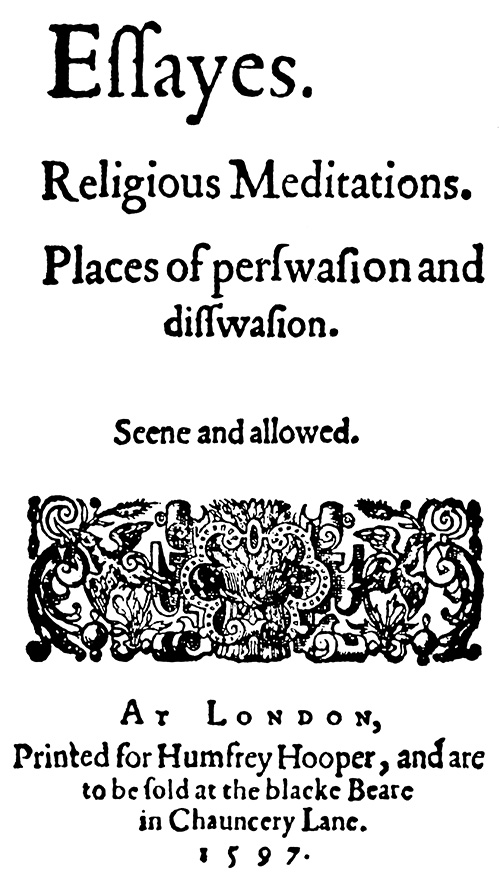
It was then that Francis Bacon began writing his own essays, the first edition of which was published in 1597, titled Essayes: Religious Meditations. Places of Perswasion and Disswasion. Seene and Allowed, which he dedicated to his "loving and beloved brother" Anthony Bacon.[ii]
As the two brothers were Christian Cabalists as well as initiates of the English Rosy Cross Society, this first edition contained just ten essays, thereby announcing the importance of the number 10 – the number of the Sephiroth ("Divine Emanations") in the kabbalistic “Tree of Life” (a diagrammatic form of the Cosmos).
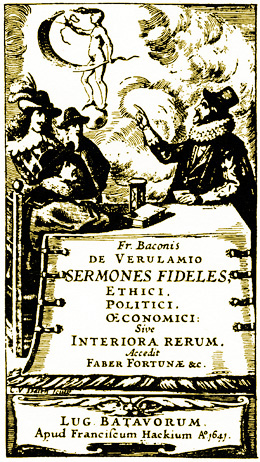
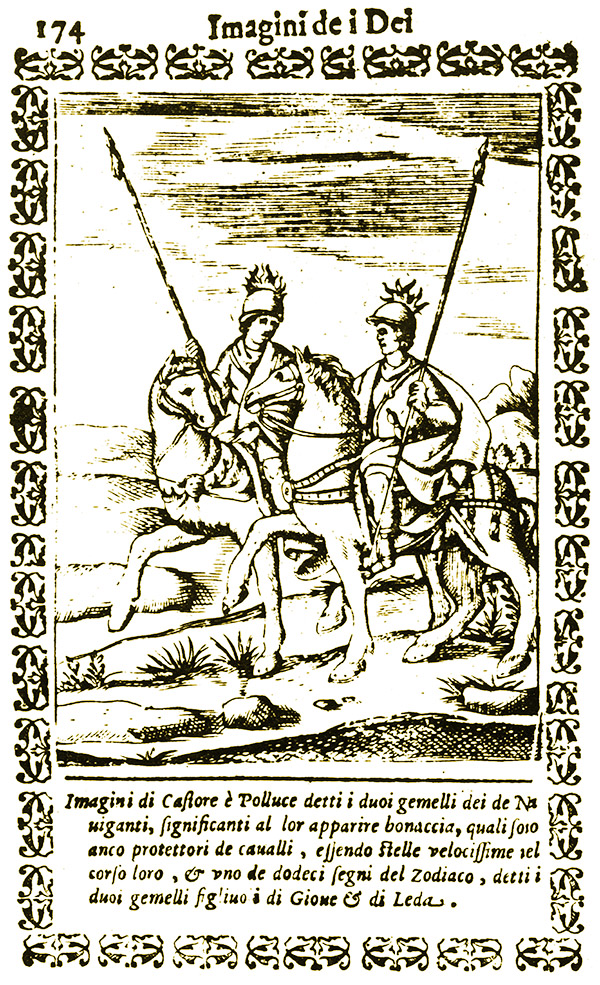
Also contained in this little book were the Meditationes Sacrae and Of the Coulers of good and evill a fragment, together with three emblems depicting the two brothers acting out their roles as the mythological Gemini (“Twins”), holding masks, banners and musical instruments, as a sign to what they were involved in doing.
A much-enlarged second edition of Francis Bacon’s Essayes appeared in 1612 with 38 essays. This was followed by a third and final edition in 1625 with 58 essays, titled Essayes or Counsels, Civill and Morall.
Montaigne’s essays, as he reports, were to record "some traits of my character and of my humours", as well as that of others. They covered subjects such as human motivation, thoughts, fears, happiness, child education, and human experience through action; in other words, they formed an observation in human psychology or human nature. The essays were also inspired by Montaigne’s studies in the classics, with quotations from Ancient Greek, Latin, and Italian texts, especially the works of Plutarch and Lucretius.
Francis Bacon’s essays do something similar, although he writes more as a lawyer, judge, historian and expert in the classics, comparing one thing with another, and deriving his conclusion usually at the end of each essay. But, like Montaigne, they are studies of human nature. Many of the observations in Bacon’s essays can be found in the Shakespeare plays.
A complete version of all 58 of his essays from the 1625 final edition, Essayes or Counsels, Civill and Morall, can be found on this website in pdf form.
Also, because nowadays it can be difficult to read each essay in its fulness, due to its Elizabethan-Jacobean style of language and spelling, and immense knowledge and use of the classics, we have chosen to share some of the essays in an edited form, as extracts, omitting what to many people might be cumbersome and off-putting:
© Peter Dawkins, FBRT
[i] An English translation by John Florio of Montaigne’s Essais was published in 1603. Many scholars believe that there are influences from them in some of the Shakespeare plays, such as Hamlet and King Lear.
[ii] This was the first publication to bear the name of Francis Bacon as author.
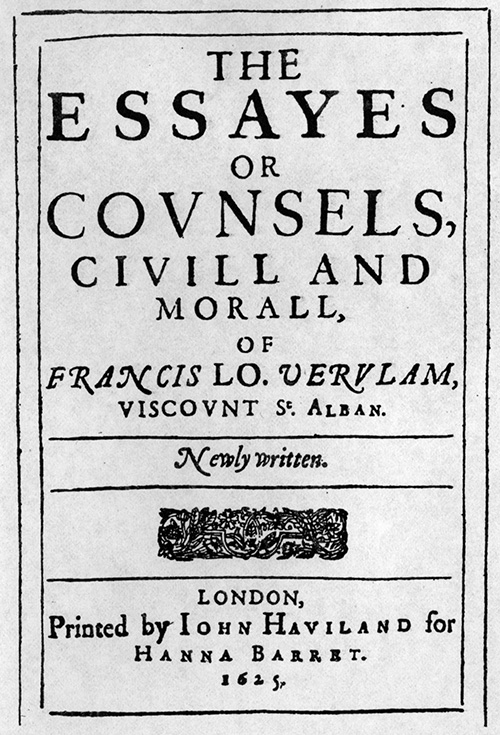
- Essayes or Counsels, Civill and Morall