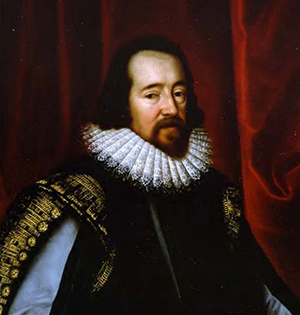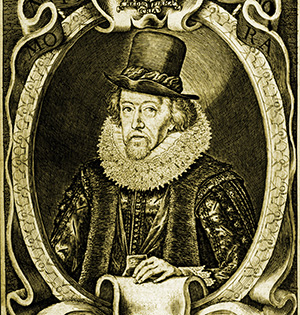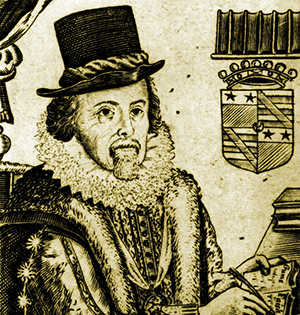
Sir Francis Bacon, Viscount Saint Alban
“In short, all that were great and good loved and honoured him.”
John Aubrey, Brief Lives – 1680-93
Sir Francis Bacon, Baron Verulam of Verulam, Viscount Saint Alban (1561-1626), was not only a recognised genius but also a man of many parts—a renowned philosopher, poet, orator, author, essayist, cryptographer, courtier, lawyer, parliamentarian, statesman, intellectual reformer and master of the English tongue. He was the first QC and KC, and in later life became Lord Keeper of the Great Seal and Lord Chancellor, with the titles Baron Verulam of Verulam and Viscount St Alban.
Much misinformation, disinformation, and even slanderous things have been written about him, mostly because of lack of knowledge or misunderstandings or prejudices stemming from the fact that he was used as a scapegoat—and has been ever since, as such misunderstandings and prejudices are easily said, spread around and believed.
For instance, he is still described as a corrupt chancellor who took bribes, even though this has been demonstrably shown over and over again not to be true. The real truth is that he was commanded by King James I of England, VI of Scotland, to plead guilty of the charges brought against him so as to protect the King and his favourite, Buckingham, who together with a few others were the real guilty ones.
Also, far from being a materialist and the supposed founder of materialism, which he is often charged with, Bacon exhorted us to look not just for the physical laws of the universe but also for the metaphysical laws, of which the highest, he declared, is the summary or universal law of love.
Moreover, he urged us to study and get to know, via experimental practice, the laws not just of the natural world but also the laws of human nature and divine nature.
Bacon pointed out that we are but servants of nature, whose laws we do, in fact, have to obey, and that any mastery is achieved purely by means of science and art, which is nature with man to help. In other words, the greatest master is the greatest servant of all.
Bacon also declared his undying belief that the whole universe has a mind or soul—an intelligence and consciousness with which everything is imbued.
Bacon knew and stated openly that wisdom lies hidden within nature—divine, human and natural—and that it is up to us to discover and use it charitably for the benefit of all life. And that for this we have the guiding help of the wisdom that is inspired into our hearts from the divine world, as well as that given us by divinely inspired prophets.
Bacon referred to wisdom as not only the Word of God but also Sophia, whom he likened to the Mistress whom we, the handmaiden, should serve devotedly, with love.
Charity, he explained, is love in action, otherwise known as philanthropy. This, he said, is the equivalent of goodness, the very character of the Deity, and without which man is a busy, mischievous, wretched thing, no better than a kind of vermin.
Bacon lived during the height of the English Renaissance and the beginning of the modern era, of which he is considered to be a major founder. Not only was he likened to Plato, as “The Third after Plato” (or “The Third Plato”), but the Royal Society, when founded, acknowledged him as their instaurator.
Similarly, in France, when Colbert in 1666 asked Huygen’s advice on how the French Academy should be developed, Huygen recommended that it should follow Bacon's plan. Diderot and d’Alembert, in their preface to the great French Encyclopaedia (published in 1751), when speaking of those to whom they were most indebted, said: -
“At the Head of these illustrious Heroes we deservedly place the immortal Francis Bacon… we are tempted to esteem him the greatest, the most universal, and most eloquent of all Philosophers. It is to this great Author we are chiefly indebted for our Encyclopaedic Plan.”
Bacon referred to himself as "the herald of the new age", and Paracelsus prophesied his appearance as "Elias the Artist... who shall reveal many things". The Order Cabbalistic de la Rosecroix described Elias the Artist as the "Genius Director of the Rose Cross... Spirit of Liberty, of Science and Love which must regenerate the world." Dr. John Wilkins, the first Secretary of the Royal Society, referred to the Father of the Rosy Cross fraternity (‘Fra. R.C.’ or ‘Fra. C.R.C.’) as "Francis Rosicross". Bacon's Christian name 'Francis' means 'free', a word derived from Sanskrit pri meaning 'love'.
Bacon was a man of mystery—a Freemason, Rosicrucian and “concealed poet”, acknowledged as “The very nerve of genius, the marrow of persuasion, the golden stream of eloquence, the precious gem of concealed literature,” the “Light-bearer” and “Day-Star of the Muses”, “leader of the choir of Muses and their disciples,” and renovator of Philosophy by means of “walking humbly in the socks of Comedy” and “rising on the loftier buskin of Tragedy” (i.e. stage plays). 1
Likened to both Apollo and Pallas Athena, the Spear-shaker, Bacon led a studio of “good pens” (poets, writers, intelligencers and scribes), and both inaugurated and led the Shakespeare scene.
Clues to his mystery are given in his unique titles, Baron Verulam of Verulam, which means ‘Spear-shaker of Verulamium’, and Viscount St Alban, the same name as that given to the Romano-British St Alban, founder and first Grand Master of Operative Freemasonry in England. Francis Bacon was the second St Alban, founder and first Grand Master of Speculative Freemasonry in England. The higher degrees of the original Speculative Freemasonry were those of the Rose Cross.
Bacon called his grand project ‘The Great Instauration’, and all those who take part in it, according to Bacon's New Atlantis, are considered to be members of Salomon's House (i.e. Solomon's House), otherwise known as the College of the Six Days Work.
Salomon’s House refers to the Temple of Solomon, which is its archetype. The use of the word ‘instauration’ refers to the instauration or rebuilding of Solomon’s Temple in a more beautiful or exalted way than before, after the first Temple of Solomon was destroyed. Solomon's Temple was built, and then rebuilt, by operative Freemasons, who were directed and overseen by Rosicrucians and their three Grand Masters or Principals.
The Six Days Work refers to the Six Days of Creation as given in Genesis, chapter 1, the first book of the Holy Bible and Hebrew Torah. The Six Days of Creation is the archetype for the Six Stages (called Parts or Books) of the Great Instauration.
Bacon said that he was “laying a foundation in the human understanding for a holy Temple after the model of the World”, and that “surely, as nature createth brotherhood in families, and arts mechanical contract brotherhoods in commonalities, and the anointment of God superinduceth a brotherhood in kings and bishops; so in like manner there cannot but be a fraternity in learning and illumination, relating to that paternity which is attributed to God, who is called the Father of illuminations or lights.”2
Bacon was a Hermeticist and Christian Cabalist,3 who was fluent in ancient Hebrew as well as other classical and modern languages. One of the maxims of Kabbalah/Cabala is that some things should be revealed and some things should be hidden, so that to find the truth we have to make the effort to search for it.
This treasure hunt is allegorised in the Bible as a game of hide and seek,4 wherein God hides the truth in order that man should seek to find it, and in Freemasonry as the search for the Lost Word. The absolute importance of this to Bacon is made clear in his writings, wherein he says that the glory of man is to play God's game of hide and seek,5 and to imitate God, as we are made in God's image.6
Bacon believed in this proverbial wisdom of Solomon, as also in the teachings of Jesus and the biblical account of Creation as esoterically understood. The “New Method” that Bacon gave to mankind, which he calls the “Art of Discovery”, is based on this wisdom.
Bacon said that he would provide a practical example of this Art of Discovery in order to teach us the method; but he doesn’t actually tell us what the practical example is or where to find it, other than providing the hint of the game of hide and seek, and mentioning that “the Art of Discovery can grow together with Discovery itself.”7
Like any game of hide and seek or treasure hunt, it requires clues—and the clues have been left in abundance for those with eyes to see and ears to hear.